


 English
 中文简体
中文简体 Español
Home / News / Industry News / How Do You Optimize the Layout of a Low Temperature (-18~-35℃) High Energy Efficiency Evaporator?
Industry News
Content
In refrigeration systems operating within the -18°C to -35°C range, the evaporator is the component most directly responsible for heat absorption performance and system energy consumption. Unlike medium-temperature applications where operating margins are more forgiving, ultra-low temperature systems demand exceptional precision in every aspect of evaporator design and placement. A poorly optimised layout increases pressure drop across the coil, reduces refrigerant distribution uniformity, accelerates frost accumulation, and forces the compressor to work harder to maintain setpoint temperatures—all of which compound into significant energy penalties over the system's operational life. Conversely, a carefully engineered evaporator layout can reduce energy consumption by 15–30% compared to a default or poorly considered arrangement, while simultaneously improving temperature uniformity inside the refrigerated space and extending defrost intervals. This article provides practical, engineering-level guidance on the key layout optimisation decisions that determine whether a low-temperature evaporator system reaches its full efficiency potential.
Before optimising layout, engineers must understand the specific physical challenges that distinguish ultra-low temperature evaporator design from standard refrigeration applications. At operating temperatures between -18°C and -35°C, several interacting phenomena make layout decisions far more consequential than at higher temperature ranges.
Refrigerant vapour density increases significantly at low evaporating pressures, which means that suction line velocity and pressure drop management become critical. Common refrigerants such as R-404A, R-507A, R-448A, and R-449A all exhibit substantially higher pressure drop per unit length at ultra-low temperatures compared to medium-temperature operation. A pressure drop equivalent to just 1°C of saturation temperature loss across the evaporator coil translates directly into a compressor suction pressure reduction that increases energy consumption by approximately 3–4%. Managing refrigerant-side pressure drop through coil circuiting design and layout is therefore a primary efficiency lever at these temperatures.
Frost formation is the second major challenge specific to low-temperature operation. As evaporator surface temperatures drop well below 0°C, any moisture in the air stream deposits as frost on the fin and tube surfaces. Frost acts as an insulating layer that progressively reduces heat transfer efficiency—a frost layer of just 3 mm can reduce coil heat transfer coefficient by 20–30%. Layout decisions that affect airflow distribution across the coil face, frost accumulation patterns, and drainage of meltwater during defrost cycles have a direct and measurable impact on long-term system energy performance.
The internal circuiting of the evaporator coil—how the refrigerant flow is divided, routed, and recombined within the coil—is the single most important design variable for achieving uniform heat transfer and minimising pressure drop at low temperatures. Poor circuiting produces uneven refrigerant distribution across the coil face, leaving portions of the heat transfer surface operating at sub-optimal conditions while other sections are overloaded.
For ultra-low temperature evaporators, parallel multi-circuit configurations are strongly preferred over long single-circuit arrangements. Dividing the total refrigerant flow into multiple shorter parallel paths reduces the velocity and friction losses within each circuit while maintaining adequate mass flux for nucleate boiling heat transfer. A typical -30°C evaporator coil with a face area of 1.5 m² might use 6–10 parallel circuits, each covering a vertical slice of the coil. The number of circuits should be calculated based on the refrigerant mass flow rate, the target circuit pressure drop (typically 0.3–0.5 bar for low-temperature applications), and the minimum mass flux required to ensure adequate liquid-vapour mixing—generally 150–300 kg/m²·s for low-temperature refrigerants.
The expansion device and refrigerant distributor must deliver equal flow to each parallel circuit under all operating conditions, including partial-load situations when evaporating pressure fluctuates. Venturi-type distributors with individually matched capillary feed tubes are more reliable than simple tee-branch distributors for achieving balanced distribution at low temperatures. The distributor body should be positioned vertically with upward refrigerant flow where possible, preventing liquid-vapour separation under gravity that would cause uneven circuit feeding. At operating temperatures below -25°C, electronic expansion valves offer superior capacity modulation and distribution control compared to thermostatic expansion valves, whose sensing bulbs can become sluggish at extreme temperatures.
The air-side layout of a low-temperature evaporator—how air is directed across the coil face, the velocity at which it passes, and how it is distributed within the refrigerated space—is as important to efficiency as the refrigerant-side circuiting. Fan selection and positioning decisions made at the layout stage have lasting consequences for both energy consumption and temperature uniformity.
Face velocity—the average air velocity measured perpendicular to the coil face—must be carefully balanced at low temperatures. Higher face velocities increase the convective heat transfer coefficient on the air side, improving coil performance, but they also accelerate moisture entrainment and frost accumulation, increasing defrost frequency and energy penalty. For evaporators operating in the -18°C to -35°C range, optimum face velocities typically fall between 1.5 and 2.5 m/s. Below 1.5 m/s, heat transfer efficiency drops and air distribution becomes uneven; above 2.5 m/s, frost bridging between fin rows accelerates dramatically, shortening operating intervals between defrosts. Variable-speed fan drives that modulate airflow based on load conditions offer the best compromise, running at reduced speed during low-demand periods to minimise frost formation and defrost energy consumption.
Multiple smaller fans distributed evenly across the coil face provide more uniform air velocity distribution than a single large fan at one end of the unit. Uneven velocity profiles leave low-velocity regions where frost preferentially accumulates and high-velocity regions where excessive moisture carryover occurs. For evaporators wider than 800 mm, a minimum of two fans positioned symmetrically is recommended. Fan spacing should be designed so that the airflow cones from adjacent fans overlap at the coil face, eliminating dead zones. Centrifugal fans are preferred for longer coil depths (more than 6 tube rows) as they maintain static pressure better against the higher resistance of deep frost-laden coil sections.
Fin pitch—the spacing between individual fins on the coil—has a disproportionately large impact on low-temperature evaporator performance because it directly controls the rate at which frost bridges between adjacent fins and blocks airflow. Standard medium-temperature evaporators often use fin pitches of 4–6 mm; for operation at -18°C to -35°C, wider fin pitches of 7–12 mm are typically specified to extend the interval between defrost cycles and reduce the airflow restriction caused by frost accumulation. Wider fin pitches reduce the total fin surface area available for heat transfer, which means the coil must compensate through additional rows of tubes or increased face area—a trade-off that must be evaluated through detailed coil performance modelling rather than rule-of-thumb selection.
Coil depth—measured by the number of tube rows in the direction of airflow—affects both heat transfer effectiveness and air-side pressure drop. Deeper coils extract more heat per unit of face area but impose higher static pressure losses that must be overcome by fan power. For ultra-low temperature applications, 4–8 tube rows represent the practical optimum range, with the specific selection depending on the available face area, the required cooling capacity, and the target fan energy consumption. Beyond 8 rows, the incremental heat transfer gain per additional row diminishes sharply while fan power requirements continue to increase linearly.
Defrost system design is inseparable from evaporator layout optimisation at ultra-low temperatures because defrost energy consumption can represent 15–25% of total system energy use in -30°C to -35°C applications. The layout decisions that affect frost accumulation patterns directly determine defrost frequency, duration, and energy input requirements.
Hot gas defrost, which uses discharge gas from the compressor to warm the evaporator coil from the inside, is consistently more energy-efficient than electric resistance defrost at ultra-low temperatures, typically consuming 40–60% less energy per defrost cycle. The layout implication is that the evaporator must be positioned within practical piping distance of the compressor rack to limit hot gas line pressure drop and heat loss. When hot gas defrost is specified, the coil circuiting must include dedicated defrost gas inlet and drain connections, and the coil orientation should facilitate gravity drainage of meltwater toward the drain pan without refreezing on internal surfaces.
At ultra-low temperatures, inadequate drain pan design causes meltwater to refreeze before it exits the unit, progressively blocking the drain and reducing defrost effectiveness. Drain pans for -18°C to -35°C evaporators should incorporate electric trace heating on the pan surface and drain pipe, with sufficient slope (minimum 1:50 gradient) to ensure complete drainage before the system returns to cooling mode. The drain pipe diameter should be generously sized—a minimum of 25 mm internal diameter—to prevent blockage by ice crystals carried in the meltwater stream. Positioning the evaporator unit so the drain pan outlet connects to an internal, heated drain line rather than an external pipe exposed to ambient temperatures prevents refreezing in the drain system during pull-down after defrost.
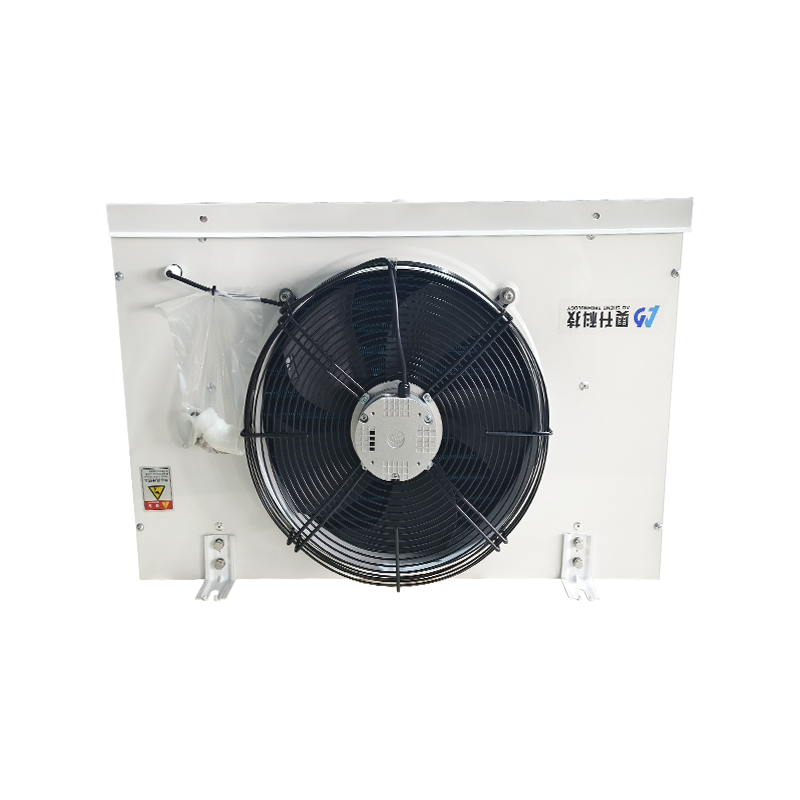
The physical positioning of the evaporator unit within the refrigerated space determines how effectively cooled air reaches all areas of the room and how quickly temperature setpoint is restored after door openings or product loading. Poor positioning creates warm spots, increases average room temperature, and forces longer compressor run times to compensate for uneven cooling distribution.
Key positioning principles for low-temperature cold stores and blast freezers include:
The following table summarises the key performance parameters that distinguish a well-optimised low-temperature evaporator layout from a standard or default arrangement, providing measurable targets for design validation and commissioning acceptance testing:
| Parameter | Standard Layout | Optimised Layout | Efficiency Gain |
| Coil pressure drop | 0.8–1.2 bar | 0.3–0.5 bar | 8–12% compressor energy saving |
| Defrost frequency | 4–6 per day | 2–3 per day | 40–50% defrost energy reduction |
| Temperature uniformity | ±4–6°C variation | ±1–2°C variation | Improved product quality |
| Face velocity | 3.0–4.0 m/s | 1.5–2.5 m/s | Reduced frost rate, lower fan power |
| Fin pitch | 4–6 mm | 7–12 mm | Extended defrost interval |
| Overall system COP | 0.8–1.0 | 1.1–1.4 | 15–30% total energy reduction |
Optimising the layout of a low-temperature high energy efficiency evaporator operating in the -18°C to -35°C range is not a single design decision but a sequence of interconnected engineering choices—coil circuiting, fin geometry, airflow management, defrost integration, and room positioning—each of which builds on the others to produce a system that consistently achieves its rated efficiency across its operational life. The compounding nature of these optimisations means that getting each decision right produces benefits that exceed the sum of the individual improvements: reduced compressor suction pressure drop, lower defrost energy consumption, extended operating intervals, and more uniform temperature distribution all reinforce each other to deliver the full efficiency potential of the evaporator design. Engineers and refrigeration contractors who approach ultra-low temperature evaporator layout with this systematic, evidence-based mindset will consistently achieve systems that outperform default specifications by significant and measurable margins.

For exclusive deals and latest offers, sign up by entering your email address below.

We specialise in the refrigeration industry. Please feel free to contact us.
