


 English
 中文简体
中文简体 Español
Home / News / Industry News / What Are the Three Main Design Standards That Govern Water Cooled Condensing Units?
Industry News
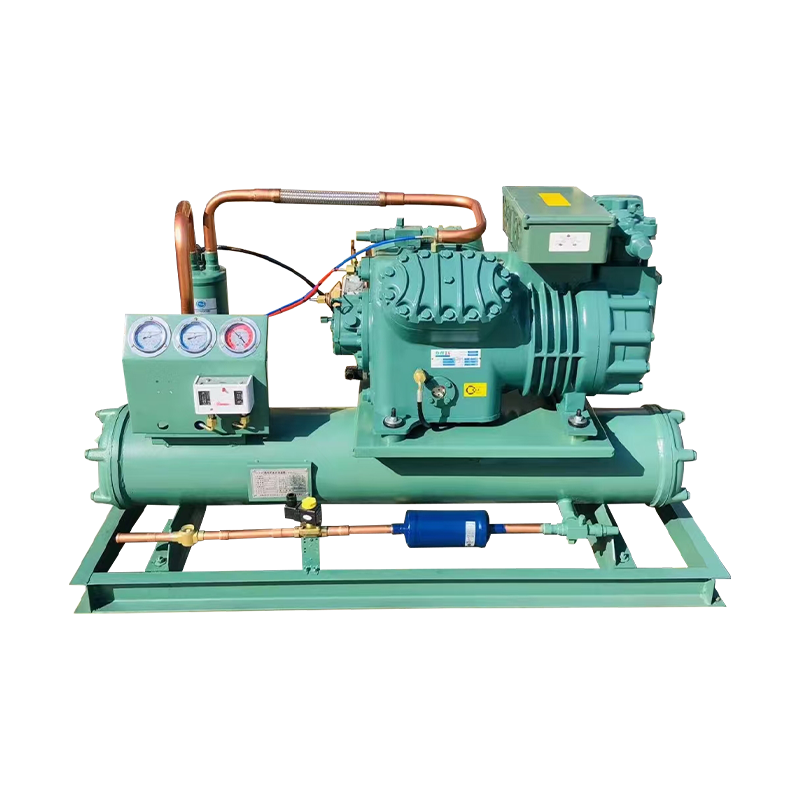
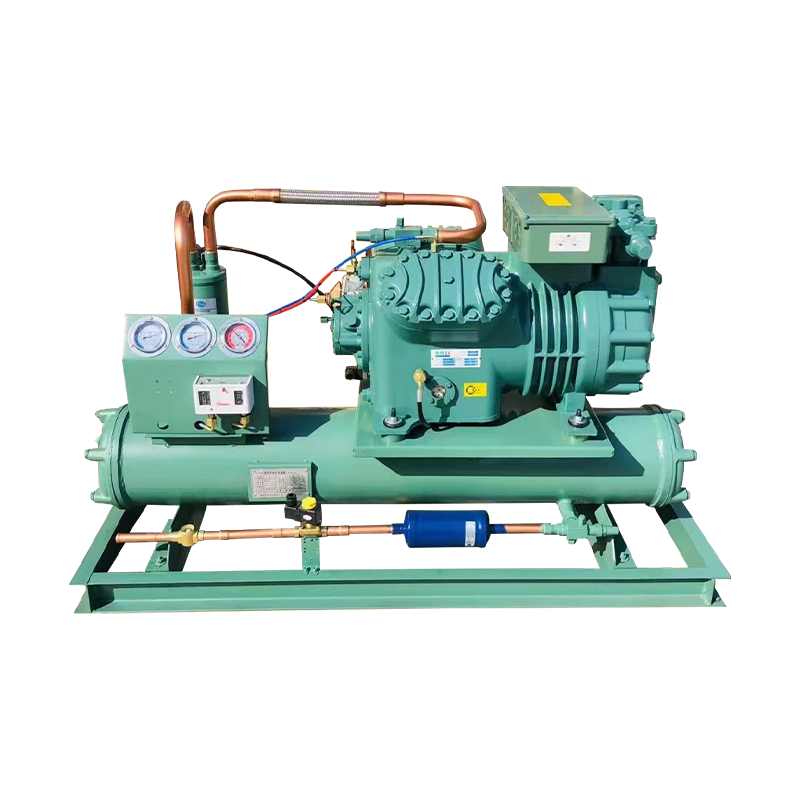
Water cooled condensing units are a cornerstone of commercial and industrial refrigeration in facilities where air-cooled equipment is impractical — including high-rise buildings, densely packed plant rooms, data centres, food processing facilities, and pharmaceutical cold storage. Unlike their air-cooled counterparts, water cooled units reject heat through a water circuit connected to a cooling tower, dry cooler, or municipal water supply, allowing them to operate at lower condensing temperatures, achieve superior energy efficiency, and function reliably in high-ambient indoor environments where adequate air movement for heat rejection is unavailable.
However, the integration of pressurised refrigerant circuits with pressurised water circuits, the variety of industrial environments in which they are deployed, and the safety implications of failure make design standardisation essential. Three principal design standards govern the engineering, manufacture, testing, and installation of water cooled condensing units: standards covering pressure vessel and heat exchanger design, standards addressing refrigeration system safety and component requirements, and standards defining energy efficiency measurement and minimum performance thresholds. Each of these frameworks addresses a distinct aspect of system design, yet all three must be satisfied simultaneously for a unit to be considered fit for commercial deployment.
Content
The water cooled condenser — the component that transfers heat from the refrigerant circuit to the water circuit — is a pressure vessel. It contains refrigerant on one side at elevated pressure and water on the other, and its integrity under operating and test conditions is non-negotiable. The design standards that apply to this component are drawn from pressure equipment legislation and heat exchanger engineering codes, and they dictate wall thicknesses, material specifications, test pressures, and welding or brazing quality requirements.
In European markets, the Pressure Equipment Directive (PED 2014/68/EU) is the primary legislative framework governing the design and manufacture of pressure vessels and heat exchangers used in water cooled condensing units. The directive classifies pressure equipment into categories based on the fluid group, maximum allowable pressure (PS), and volume or pipe diameter, with higher categories attracting more stringent conformity assessment requirements. Shell-and-tube condensers and brazed plate heat exchangers used in commercial water cooled condensing units typically fall into Category I through Category III, depending on their size and operating pressures.
Under the PED, manufacturers must apply the CE marking to conforming equipment and provide a Declaration of Conformity. Heat exchangers in higher categories must be assessed by a Notified Body — an accredited third-party organisation — which reviews design calculations, material certificates, and weld inspection records before certification is granted. For the brazed plate heat exchangers widely used in compact water cooled condensing units, the PED requires that the design pressure on both the refrigerant and water sides is established and marked on the unit, and that the equipment has been hydraulically pressure-tested to at least 1.43 times the maximum allowable pressure before leaving the factory.
In North American markets, the ASME Boiler and Pressure Vessel Code — specifically Section VIII, Division 1 for unfired pressure vessels — sets out the equivalent requirements for heat exchanger and condenser design. ASME Section VIII governs material selection, design calculations for shells, heads, nozzles and flanges, fabrication processes, non-destructive examination requirements, and pressure testing protocols. Shell-and-tube condensers manufactured to ASME Section VIII carry the ASME U-stamp, which certifies that the vessel has been designed, fabricated, inspected, and tested by an ASME-authorised manufacturer and independently verified by an Authorised Inspector.
The U-stamp is frequently specified by consulting engineers and end users on North American projects as a non-negotiable procurement requirement, particularly for large industrial water cooled condensing units used in food processing, chemical production, and institutional facilities. Its absence on a heat exchanger component can disqualify a unit from consideration regardless of its other technical merits, underscoring how directly design standards translate into commercial requirements.
The choice between brazed plate heat exchangers (BPHEs) and shell-and-tube condensers in water cooled condensing unit design is partly driven by pressure vessel standards. BPHEs offer compact size, high heat transfer efficiency, and low refrigerant charge, but their all-brazed construction makes field repair impossible — a failed BPHE must be replaced entirely. Shell-and-tube condensers are larger and heavier but can be retubed and repaired in the field, and their construction lends itself more naturally to ASME U-stamp certification for high-pressure applications. Many manufacturers offer both condenser types to serve different regulatory markets and project specifications.
Beyond the pressure vessel itself, the complete refrigeration circuit of a water cooled condensing unit — including the compressor, refrigerant pipework, safety relief devices, electrical controls, and refrigerant containment provisions — is governed by refrigeration system safety standards. These standards address the hazards unique to refrigeration equipment: refrigerant toxicity and flammability, high operating pressures, electrical safety in potentially wet environments, and the risks associated with refrigerant leakage in occupied spaces.
EN 378 is the governing European standard for the safety of refrigerating systems and is directly referenced in the design of water cooled condensing units across the EU and in many international markets that adopt European standards by reference. The standard is structured in four parts covering basic requirements and definitions, design, construction, testing, marking and documentation, installation sites, and operation and maintenance. For water cooled condensing unit manufacturers, Parts 1 and 2 are the most directly applicable during the design phase.
EN 378 classifies refrigerants by safety group — combining toxicity (Class A for lower toxicity, Class B for higher toxicity) with flammability (Group 1 for non-flammable, Group 2L for lower flammability, Group 2 and 3 for flammable) — and uses these classifications to establish maximum refrigerant charge limits in occupied spaces, minimum room volumes for refrigerant containment, and requirements for leak detection and ventilation. For water cooled units used in plant rooms, EN 378 Part 3 specifies the ventilation rates required to prevent dangerous refrigerant accumulation in the event of a leak, and mandates refrigerant leak detection systems above certain charge thresholds.
The following table summarises the EN 378 safety group classifications for refrigerants commonly used in water cooled condensing units:
| Refrigerant | EN 378 Safety Group | Flammability | Leak Detection Required |
|---|---|---|---|
| R-134a | A1 | Non-flammable | Above charge threshold |
| R-410A | A1 | Non-flammable | Above charge threshold |
| R-32 | A2L | Mildly flammable | Mandatory in occupied spaces |
| R-1234ze | A2L | Mildly flammable | Mandatory in occupied spaces |
| R-744 (CO₂) | A1 | Non-flammable | CO₂ concentration monitoring required |
In North America, ASHRAE Standard 15 — Safety Standard for Refrigeration Systems — performs an equivalent function to EN 378. It governs the design, construction, installation, and operation of refrigerating systems and is referenced in building codes across the United States and Canada, including the International Mechanical Code (IMC) and the International Building Code (IBC). ASHRAE 15 classifies refrigerants using the same A/B toxicity and 1/2L/2/3 flammability scheme as ISO 817, and uses these classifications to establish occupancy-based refrigerant quantity limits, machinery room ventilation requirements, and emergency pressure relief discharge routing provisions. For water cooled condensing units installed in machinery rooms serving occupied buildings — hotels, hospitals, office towers, and data centres — compliance with ASHRAE 15 is a prerequisite for building permit approval and insurance coverage.
The third major design standard domain covers energy efficiency — both the methodology for measuring and declaring the efficiency of water cooled condensing units and, in an increasing number of jurisdictions, the minimum efficiency levels that units must achieve to be legally placed on the market. Energy efficiency standards for water cooled condensing units serve two functions: they provide a standardised basis for comparing products from different manufacturers under equivalent conditions, and they drive progressive improvement in the energy performance of equipment across the industry.
In North America, AHRI Standard 365 establishes the rating conditions and test methods used to measure and declare the performance of water cooled commercial condensing units. The standard defines the entering water temperature, water flow rate, evaporating temperature, and refrigerant type at which capacity and efficiency measurements are made, ensuring that published performance data is generated under consistent, reproducible conditions. Without such standardisation, manufacturers could cherry-pick favourable test conditions that inflate apparent performance, making product comparison meaningless.
AHRI certification programmes allow manufacturers to have their published ratings independently verified through third-party testing at accredited laboratories. Products that carry AHRI certification provide engineers and buyers with assurance that the rated capacity and efficiency will be achieved under the specified conditions — a significant procurement safeguard for large commercial projects where unit selection is based on computer-modelled energy simulations.
In the European Union, the Ecodesign Regulation framework — implemented through a series of product-specific regulations — establishes minimum energy performance standards that water cooled condensing units must meet to be sold in EU member states. Rather than rating efficiency at a single operating point, EU regulations increasingly require manufacturers to declare Seasonal Energy Performance Ratio (SEPR) values — a weighted average efficiency figure that accounts for the varying load and water temperature conditions the unit experiences across a full year of operation. SEPR is a more realistic predictor of annual energy consumption than single-point COP values and incentivises design features such as variable-speed compressors and floating condensing pressure control that improve part-load efficiency.
Key design implications of energy efficiency standards for water cooled condensing units include:
In practice, the three design standard domains — pressure vessel and heat exchanger standards, refrigeration system safety standards, and energy efficiency standards — are not independent. Decisions made to satisfy one standard directly affect compliance with the others, and experienced design engineers navigate these interactions as an integral part of the unit development process.
For example, selecting a low-GWP refrigerant such as R-1234ze to satisfy F-Gas and Ecodesign requirements introduces A2L flammability classification under EN 378, which in turn requires leak detection equipment and specific plant room ventilation provisions under the safety standard. Simultaneously, R-1234ze operates at lower pressures than R-134a, which affects the pressure rating requirements and wall thickness calculations for the heat exchanger under the PED or ASME BPVC. Managing these interdependencies is not a bureaucratic exercise — it is fundamental systems engineering that determines whether the completed unit is safe, legal, and commercially competitive across its target markets.
Manufacturers who design water cooled condensing units with all three standard domains addressed from the outset produce equipment that can be certified, sold, installed, and operated globally with minimal market-specific re-engineering. Those who treat standards as an afterthought encounter costly redesign cycles, delayed market entry, and the reputational risk of equipment that fails regulatory scrutiny at the point of installation approval. For specifying engineers and procurement teams, verifying that a shortlisted product carries the relevant certifications — CE marking under the PED, ASME U-stamp where required, EN 378 or ASHRAE 15 compliance documentation, and AHRI certification or EU Ecodesign conformity — is the most direct way to confirm that a water cooled condensing unit has been designed to the standards its application demands.

For exclusive deals and latest offers, sign up by entering your email address below.

We specialise in the refrigeration industry. Please feel free to contact us.
